
3 Acupressure Points for Anxiety, Stress, Sadness, and Emotional Calm: A Simple Traditional Chinese Medicine Practice to Calm the Shen

Have you ever felt anxious even when you were trying to relax?
Maybe your thoughts keep moving from one worry to another. Perhaps you feel emotionally heavy, restless, overwhelmed, or simply not like yourself.
During moments like these, sometimes the first thing we need is not another task to complete. We need a moment to become still.
Traditional Chinese Medicine (TCM) offers a simple wellness practice that may help encourage relaxation and emotional balance: acupressure.
Acupressure involves applying comfortable finger pressure to specific acupuncture points on the body. You don't need needles or complicated equipment, and a simple routine can take only a few minutes.
Three points traditionally used for calming the mind and supporting the Shen are:
Heart 7 (HT 7) — Shenmen
Pericardium 6 (PC 6) — Neiguan
Yintang — Hall of Impression
Let's explore where they are and how you can incorporate them into a gentle self-care practice.
What Is Acupressure?
Acupressure is a practice related to acupuncture in which fingers or thumbs are used to stimulate specific points on the body.
In Traditional Chinese Medicine, these points are understood within a larger system involving channels, Qi, organ systems, and patterns of balance.

Acupressure is not the same as receiving acupuncture from a licensed practitioner. However, it provides a simple way to incorporate gentle point stimulation into a wellness routine.
For emotional wellness, several points are traditionally selected to calm the Shen.
What Is the Shen in Traditional Chinese Medicine?
In TCM, Shen is commonly translated as spirit or mind.
The Shen is traditionally associated with the Heart and encompasses aspects of consciousness, emotional presence, mental activity, and sleep.
When the Shen feels settled, we may experience greater emotional steadiness and mental quiet.
During periods of stress, grief, worry, emotional strain, or poor sleep, we may instead feel restless, scattered, tense, or unable to settle.
This is where a quiet practice involving breathing and acupressure can become useful.
The goal isn't to force an emotion to disappear.
Instead, the practice gives you an opportunity to slow down and reconnect with yourself.
Acupressure Point #1: HT 7 — Shenmen
Where is Heart 7?
Heart 7 (HT 7), also called Shenmen or "Spirit Gate," is located directly on the wrist crease toward the little-finger side of the wrist.

More precisely, the acupuncture point is found at the ulnar end of the transverse wrist crease, in the depression radial to the pisiform and flexor carpi ulnaris tendon.
An easy reminder is:
Little-finger side + wrist crease = HT 7 area.
Why is HT 7 used?
In Traditional Chinese Medicine, HT 7 is an important point for calming the Shen.
Practitioners may select it as part of a broader treatment strategy for patterns involving emotional restlessness, agitation, difficulty settling the mind, and disturbed sleep.
How to apply acupressure to HT 7
Turn one hand so the palm faces upward.
Locate the wrist crease and move toward the little-finger side.
Using the thumb of your opposite hand, apply comfortable pressure to HT 7 for approximately 30–60 seconds.
Breathe slowly.
Release and repeat on the opposite wrist.
Acupressure Point #2: PC 6 — Neiguan
Where is PC 6?
Pericardium 6 (PC 6), or Neiguan, is located on the inner forearm approximately 2 cun above the wrist crease, between the tendons of palmaris longus and flexor carpi radialis.

In TCM, PC 6 has several traditional applications and is frequently incorporated into treatments involving the Heart, chest, stomach, and Shen.
Why is PC 6 used for emotional wellness?
PC 6 is traditionally used to regulate the Heart and calm the Shen.
For a simple self-care practice, you can think of PC 6 as a point to incorporate when emotional tension seems to accompany physical tension.
How to apply acupressure to PC 6
Turn your palm upward.
Locate the inner wrist crease.
Find the PC 6 area approximately 2 cun above the crease, between the two central tendons.
Apply comfortable pressure with your thumb for approximately 30–60 seconds.
Breathe slowly and repeat on the other arm.
Acupressure Point #3: Yintang — Hall of Impression
Have you ever automatically rubbed the area between your eyebrows when you were stressed?
Interestingly, this is also the location of an important traditional acupuncture point.
Where is Yintang?
Yintang is located at the midpoint between the inner ends of the eyebrows.

Unlike HT 7 and PC 6, you only need to locate one Yintang point.
Why is Yintang used?
Yintang is commonly selected in acupuncture and acupressure practices when the goal includes calming mental restlessness and encouraging relaxation.
How to apply acupressure to Yintang
Place your index or middle finger gently between your eyebrows.
Apply light, comfortable pressure.
You can hold the point still or use very small circular movements.
Continue for approximately 30–60 seconds while breathing slowly.
Allow your forehead to soften.
Relax your jaw.
Let your shoulders drop naturally.
Try This Simple 3-Minute Acupressure Routine
You don't need an elaborate wellness routine.
Start with three points:
1. HT 7 — Shenmen
Apply gentle pressure to each wrist for 30–60 seconds.
2. PC 6 — Neiguan
Apply gentle pressure to each inner forearm for 30–60 seconds.
3. Yintang — Hall of Impression
Finish by gently holding the point between your eyebrows.
As you move through the points, allow your breathing to become comfortable and unhurried.
You might quietly repeat:
I am here.
I can slow down.
I can give myself this moment.
The purpose isn't perfection.
It is presence.
Acupressure and the Three Treasures:
Jing, Qi, and Shen
At Kicotan Wellness, we explore health and wellness through the Traditional Chinese Medicine concepts of the Three Treasures: Jing, Qi, and Shen.
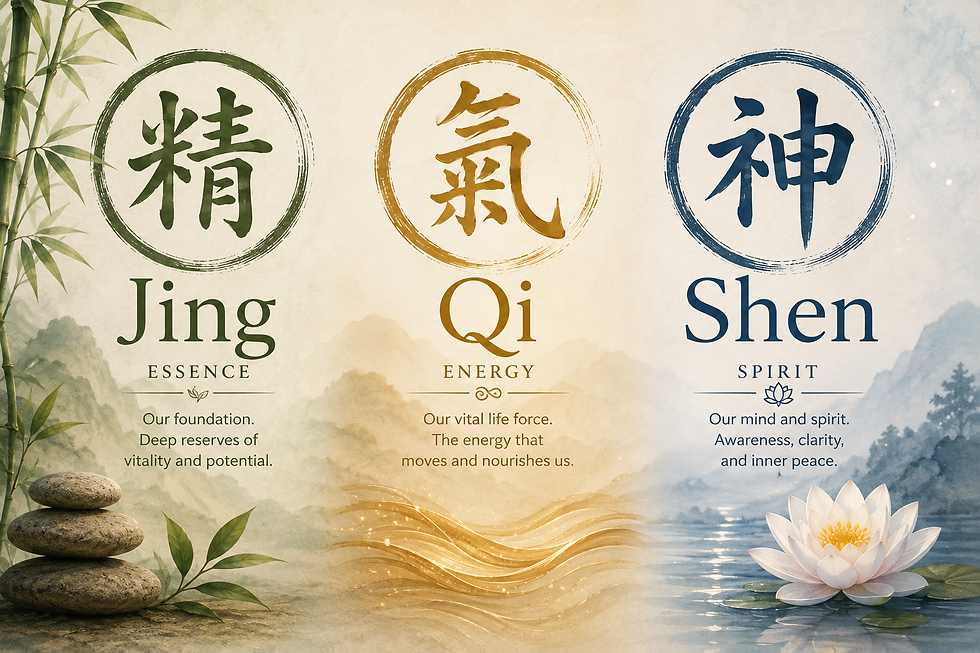
Jing represents our foundational essence.
Qi relates to the body's vital activity, movement, and functional energy.
Shen encompasses the mind, consciousness, and spirit.
These concepts remind us that wellness is not simply about addressing individual symptoms.
Sleep matters.
Movement matters.
Nourishment matters.
Emotional wellbeing matters.
Rest matters.
And sometimes something as simple as sitting quietly, breathing slowly, and practicing acupressure can become a meaningful daily ritual.
Frequently Asked Questions About Acupressure for Emotional Wellness
What are three acupressure points commonly used for relaxation and emotional calm?
Three commonly selected points are HT 7 (Shenmen), PC 6 (Neiguan), and Yintang. In Traditional Chinese Medicine, these points may be incorporated into treatments intended to calm the Shen and encourage relaxation.
Where is HT 7 located?
HT 7 is located on the wrist crease toward the little-finger side, in the depression radial to the pisiform and flexor carpi ulnaris tendon.
Where is PC 6 located?
PC 6 is located on the inner forearm approximately 2 cun above the wrist crease, between the palmaris longus and flexor carpi radialis tendons.
Where is Yintang located?
Yintang is located between the eyebrows, at the midpoint between their inner ends.
How long should I hold an acupressure point?
For a simple relaxation practice, comfortable pressure can be applied for approximately
30–60 seconds before moving to the next point.
Acupressure should not be painful.
Can acupressure treat depression?
Acupressure should not be considered a replacement for professional evaluation or treatment of depression.

It may be incorporated as a complementary relaxation or self-care practice, but persistent sadness, hopelessness, loss of interest, significant anxiety, or other concerning emotional symptoms should be discussed with a qualified healthcare or mental-health professional.
If you are in the United States and experiencing thoughts of suicide or self-harm, call or text 988 for immediate crisis support.
Begin With One Quiet Moment
You don't have to completely change your life today.
Begin with a few minutes.
Find HT 7 at your wrist.
Find PC 6 on your inner forearm.
Finish with Yintang between your eyebrows.
Breathe.
Notice how you feel.
And give yourself permission to be still for a moment.
At Kicotan Wellness, we believe meaningful wellness practices can begin with something very simple:
One point. One breath. One quiet moment at a time.
Learn more about Acupressure and Emotional Balance Ebook.
Disclaimer: This content is provided for educational and general wellness purposes only and is not intended to diagnose, treat, cure, or prevent any medical or mental-health condition. Acupressure is not a substitute for professional medical or mental-health care.
© 2026 Kicotan Wellness. All rights reserved.


Comments